Fresh Pasta Dough: professional guide to flour and technique

Fresh Pasta Dough: the Professional Guide to Flour, Technique and Consistency

Exceptional fresh pasta is never just the result of a recipe. It is the result of understanding how flour, hydration, gluten development, kneading and resting interact to create a dough that performs consistently under professional conditions.
Whether you run a pasta laboratory, a restaurant kitchen or an artisan production line, the fundamentals remain the same: mastering fresh pasta dough starts with choosing the right flour and applying the correct technique at every stage of the process.
In this guide, we’ll explore the technical foundations of fresh pasta dough, from flour selection and kneading to resting, storing and troubleshooting common production problems. Throughout the process, Molino Rachello positions itself as a technical partner for professionals seeking consistency, structure and reliable performance batch after batch.
 

The Foundation: understanding what Fresh Pasta Dough is made of

At its core, fresh pasta dough is built from only a few ingredients. However, every component has a direct technical impact on texture, elasticity, hydration and final cooking performance.
The main ingredients for pasta dough include:
  • Flour: the most important variable in the dough system. Protein content, ash level and flour strength influence elasticity, extensibility and water absorption.
  • Eggs: essential in many authentic italian pasta dough recipes. Eggs contribute hydration, fat, colour, flavour and structure.
  • Water: used alone or alongside eggs depending on the pasta style. Water quantity directly affects dough consistency and machinability.
  • Semolina: commonly used in semolina-based doughs for increased structure, rough texture and cooking resistance.
  • Salt: sometimes included in professional formulations to slightly reinforce gluten structure and flavour.
Fresh pasta dough may appear simple, but small changes in flour selection or hydration can significantly alter the final result.
 

How to Knead Fresh Pasta Dough: technique and gluten development

Understanding how to knead pasta dough correctly is essential for achieving consistency in professional production.
Kneading is not simply about combining ingredients, it is the phase where the gluten network develops and determines how the dough will behave during rolling, shaping and cooking.
Key technical principles include:
  • Develop the gluten gradually: proper kneading aligns gluten proteins into a stable network capable of handling mechanical stress.
  • Monitor dough texture carefully: the dough should feel smooth, compact and elastic without becoming overly tight.
  • Avoid under-kneading: insufficient gluten development leads to tearing during sheeting and poor structural consistency.
  • Avoid over-kneading: excessive mechanical work can create dough that is too elastic and difficult to roll.
  • Control dough temperature: heat generated during mixing can affect gluten behaviour and hydration balance.
  • Adjust based on flour characteristics: stronger flours may require different mixing times and hydration management.
A properly kneaded dough should be extensible, cohesive and capable of producing clean, consistent sheets during processing.
 

Resting the Dough: why it matters and how long to wait

One of the most common professional questions is: how long does pasta dough need to rest?
Resting is not optional. It is a critical technical phase that allows the gluten network to relax and hydration to distribute evenly throughout the dough.
During resting:
  • gluten tension decreases
  • moisture redistributes uniformly
  • the dough becomes more extensible
  • rolling and sheeting become easier
  • the risk of tearing is reduced
Skipping or shortening the resting phase often results in:
  • dough shrinkage during rolling
  • excessive elasticity
  • tearing under mechanical stress
  • inconsistent sheet thickness
In most professional contexts, fresh pasta dough should rest for at least:
  • 30-60 minutes for standard egg pasta
  • Longer for stronger flours or semolina-rich doughs
The dough should always be properly wrapped to prevent surface drying during resting.
 

Rolling and Sheeting Fresh Pasta Dough in a professional context

Rolling and sheeting are among the most delicate phases in fresh pasta production, especially in professional environments where consistency and repeatability are essential.
Whether working manually or with automated sheeters, the objective remains the same: obtaining uniform dough thickness without compromising structure.
Key considerations include:
  • Progressive reduction of thickness: reducing thickness too aggressively can damage the gluten network.
  • Consistent hydration management: uneven hydration often becomes visible during sheeting.
  • Correct dough extensibility: dough that is too elastic resists rolling; dough that is too weak tears easily.
  • Proper flour dusting: excess flour affects texture and cooking quality, while insufficient dusting increases sticking risk.
  • Machine calibration and pressure control: in professional production lines, small mechanical adjustments significantly affect final consistency.
A well-balanced dough should pass through rollers smoothly while maintaining structure and elasticity.
 

Storing Fresh Pasta Dough: best practices for a professional kitchen

Understanding how to store pasta dough correctly is essential for maintaining consistency, food safety and operational efficiency.
Professional kitchens and pasta labs must manage storage carefully to avoid hydration loss, oxidation and structural deterioration.
Best practices include:
  • Wrap dough tightly: exposure to air causes surface drying and crust formation.
  • Store at controlled refrigeration temperatures: cold storage slows enzymatic activity and preserves dough stability.
  • Avoid excessive storage times: even refrigerated dough continues to evolve over time.
  • Label batches clearly: production timing and rotation are critical for consistency.
  • Monitor humidity levels: improper refrigeration environments can dry the dough prematurely.
For most fresh pasta dough recipes, refrigerated storage within 24-48 hours provides optimal balance between flexibility and freshness.
When asking how to preserve fresh pasta or how to store fresh made pasta, professionals should always consider both food safety and dough performance, not just shelf life.
 

Troubleshooting Fresh Pasta Dough: the most common problems and how to fix them

Even experienced professionals encounter dough consistency issues. Understanding the cause behind the problem is the key to correcting it efficiently.


Dough Too Tough or Too Elastic

This problem is commonly caused by:
  • over-kneading
  • insufficient resting
  • flour that is too strong
  • hydration levels that are too low
Possible solutions include:
  • extending resting time
  • reducing mixing intensity
  • adjusting hydration slightly upward
  • selecting a flour with lower strength
Using a flour with excessively high W value for fresh pasta dough can create unnecessary elasticity that complicates rolling and shaping.
 

Dough Too Sticky or Too Dry

Sticky dough is often caused by:
  • excessive hydration
  • flour that is too weak
  • insufficient gluten development
Dry or crumbly dough may result from:
  • low hydration
  • inadequate mixing
  • over-resting without proper wrapping
  • dry ambient conditions
If pasta dough is too dry, gradual hydration adjustments are usually more effective than adding large amounts of liquid at once.
Preventive measures include:
  • precise hydration control
  • correct flour selection
  • proper wrapping during resting and storage


Dough Tearing During Rolling or Sheeting

Tearing usually indicates problems with gluten structure or hydration balance.
Common causes include:
  • insufficient resting
  • uneven hydration
  • gluten network that is too weak
  • excessive dough tension
Flour characteristics also play a major role. Protein quality and ash content directly affect extensibility and resistance under mechanical stress.
To prevent tearing:
  • ensure proper resting time
  • improve hydration uniformity
  • avoid excessive mechanical stress
  • use flour appropriate for the production method
A properly balanced dough should remain smooth and cohesive throughout the rolling process.
 

Choosing the Right Flour for your Fresh Pasta Dough: the Molino Rachello range

Flour selection determines how the dough behaves at every stage of production, from mixing and sheeting to cooking performance and final texture.
The Molino Rachello fresh pasta flour range is designed to support different professional pasta-making needs with technically consistent solutions.
 

For Egg Pasta and Stuffed Formats: dedicated balanced flours

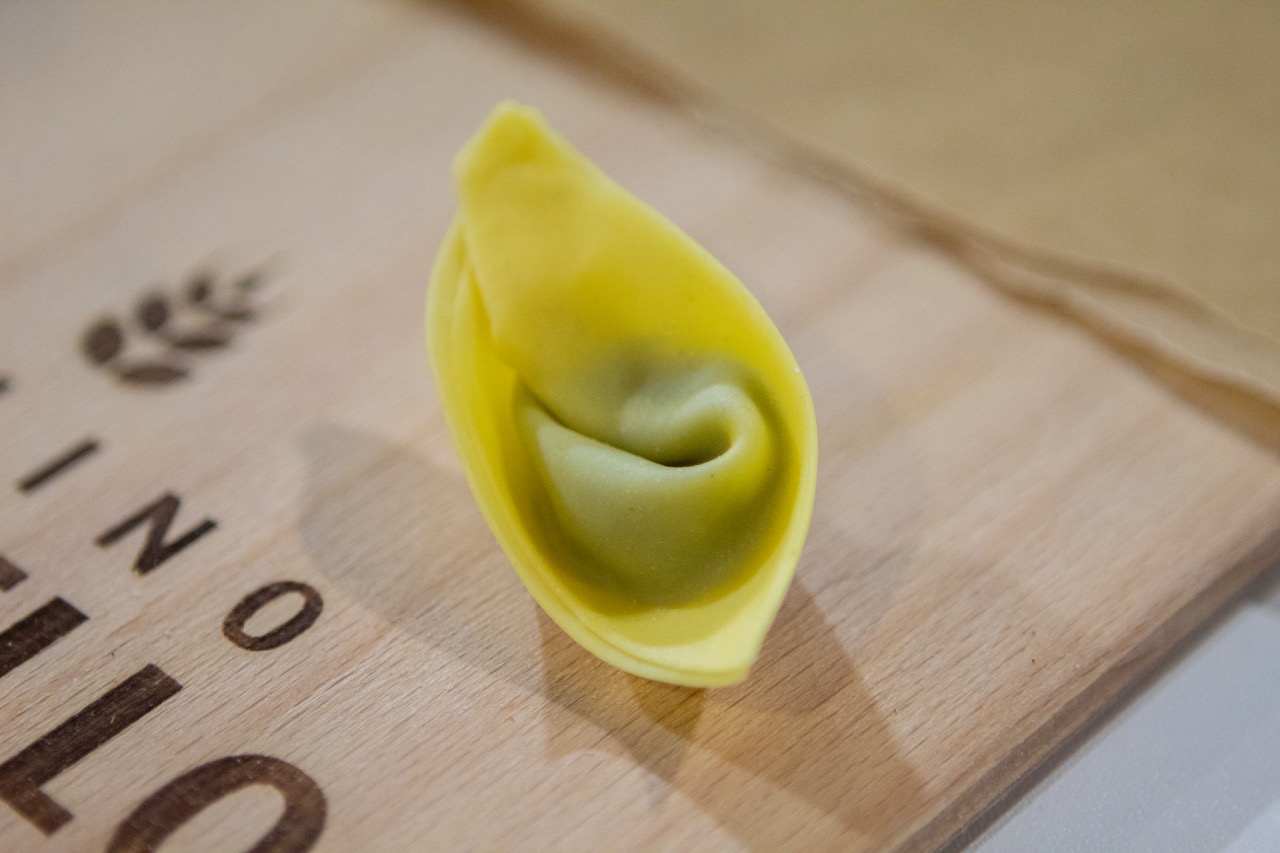
For fresh egg pasta and filled formats such as ravioli or tortellini, professionals need flours that provide:
balanced extensibility
smooth rolling performance
resistance during filling and sealing
delicate final texture
These flours support consistent dough handling without excessive elasticity.
 

For Rough Textures and Anti-Stick Use: semolina solutions

Semolina-based flours are particularly suitable for:
  • rough-textured pasta
  • improved sauce adherence
  • anti-stick dusting applications
  • enhanced cooking resistance
Their granular structure contributes to a more rustic and structured final product.
 

For Semolina-Based Doughs: strength and structure

Semolina doughs require flours capable of supporting:
  • lower hydration environments
  • mechanical resistance
  • extended cooking stability
  • firm texture development
These products are especially useful for formats requiring structural integrity during industrial or semi-industrial processing.
 

For Specialty and Premium Pasta: performance and consistency

Premium pasta production requires highly controlled flour performance.

For specialty formats and artisan productions, the ideal flour must guarantee:

  • batch-to-batch consistency
  • stable hydration absorption
  • controlled gluten development
  • clean flavour profile

This allows professionals to maintain quality standards even in demanding production environments.


Your Fresh Pasta Dough starts with the right flour. We can help you find it.

Mastering fresh pasta dough is the result of combining technical knowledge, correct process management and the right raw material.
From kneading and resting to rolling and storing, every stage depends on flour performance and consistency.
Explore the Molino Rachello fresh pasta flour range or contact the Molino Rachello team for personalised technical support.
You bring the technique. Molino Rachello brings the flour that helps make it consistent, batch after batch.

Tell us your needs

Doubts or requests about a recipe? Looking for the ideal product? Write to us and together we will find the best solution for you
;

Oasis Rachello

The best of nature, the way you like it